You are looking at
Scythians
EuropeHeartland today:  Ukraine and
  Russia
Origins are debated. Excavations at Tuva date Scythian settlement to the late 9th century BCE, while the British Museum dates the Scythian period from the 7th century BCE. Their power on the steppe faded from the 3rd to the 2nd century BCE, and a Crimean kingdom lasted until the 3rd century CE. The World History Encyclopedia has the Scythians vanish from the record in the 4th century CE.
Meanwhile…
- Maya civilization
 Mesoamerica · Oldest here
The Maya Long Count calendar tracks days in an unbroken count from a mythical starting point in 3114 BCE.
Compare - Kingdom of Kush
 Africa ·
 The Met says that under Shabaqo, the first true pharaoh of the 25th Dynasty, Egypt and Nubia formed the largest unified state in existence at the time.
Compare - Yayoi period弥生
 East Asia & Pacific ·
 The gold seal from Shikanoshima is only about 2.3 cm square and weighs 108.7 g.
Compare - Paracas culture
 South America ·
 The richest Paracas mummy bundles wrapped a single body in layer upon layer of cloth, sometimes more than a hundred separate textiles.
Compare - Sogdia
 Middle East & Central Asia · Compare
 - Anuradhapura Kingdom
 South Asia ·
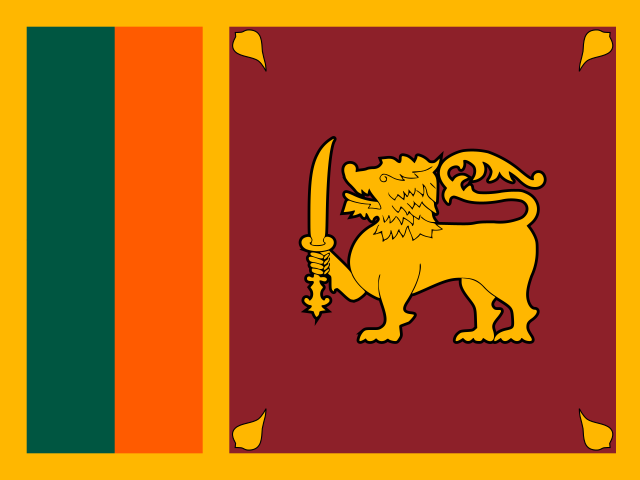
 A cutting of the Bodhi tree, brought by Sanghamitta in the 3rd century BCE, was planted at Anuradhapura, where a tree believed to descend from it still stands.
Compare
Mounted nomads who held the steppe north of the Black Sea. Herodotus described their customs, and their kurgans hold some of the finest gold work of the ancient world. Sarmatians and then Goths displaced them by the 3rd century CE.
Also alive at the same time
- Spring and Autumn period
- Warring States period
- Qin dynasty
- Han dynasty
- Chavín culture
- Paracas culture
- Maya civilization
- Olmec civilization
- Zapotec civilization
- Ancient Rome
- Celtic Iron Age
- Etruscan civilization
- Ancient Greece
- Kingdom of Macedon
- Ancient Egypt
- Kingdom of Kush
- Ancient Carthage
- Elam
- Assyria
- Babylonia
- Phoenicia
- Israel and Judah
- Achaemenid Empire
- Sogdia
- Seleucid Empire
- Parthian Empire
- Nabataeans
- Anuradhapura Kingdom
- Maurya Empire
- Yayoi period
- Xiongnu
Key events
Scythian horsemen establish themselves on the Pontic steppe north of the Black SeaDisputed
Herodotus and most modern scholars have the Scythians arrive from Asia. Dates for the move range from the late 9th century BCE (Tuva) through the late 8th century BCE (Encyclopedia of Ukraine) to the 7th century BCE (British Museum).
Sources
Also happening around
- Spring and Autumn periodChina
- Chavín cultureSouth America
- Paracas cultureSouth America
- Maya civilizationMesoamerica
- Olmec civilizationMesoamerica
- Zapotec civilizationMesoamerica
- Etruscan civilizationEurope
- Ancient GreeceEurope
- Celtic Iron AgeEurope
- Ancient RomeEurope
- Ancient EgyptAfrica
- Kingdom of KushAfrica
- Ancient CarthageAfrica
- ElamMiddle East & Central Asia
- AssyriaMiddle East & Central Asia
- BabyloniaMiddle East & Central Asia
- PhoeniciaMiddle East & Central Asia
- Israel and JudahMiddle East & Central Asia
- Kingdom of MacedonEurope (uncertain overlap)
- Jōmon periodEast Asia & Pacific (uncertain overlap)
- Yayoi periodEast Asia & Pacific (uncertain overlap)
– Darius I leads a Persian army against the Scythians, who retreat and strip the land until he withdrawsDisputed
The Encyclopedia of Ukraine dates the campaign to about 513–512 BCE. Herodotus gives no year.
Sources
Also happening around
- Spring and Autumn periodChina
- Chavín cultureSouth America
- Paracas cultureSouth America
- Maya civilizationMesoamerica
- Olmec civilizationMesoamerica
- Zapotec civilizationMesoamerica
- Etruscan civilizationEurope
- Ancient GreeceEurope
- Celtic Iron AgeEurope
- Ancient RomeEurope
- Kingdom of MacedonEurope
- Ancient EgyptAfrica
- Kingdom of KushAfrica
- Ancient CarthageAfrica
- PhoeniciaMiddle East & Central Asia
- SogdiaMiddle East & Central Asia
- Achaemenid EmpireMiddle East & Central Asia
- Jōmon periodEast Asia & Pacific (uncertain overlap)
- Yayoi periodEast Asia & Pacific (uncertain overlap)
– Scythian elites are buried in steppe mounds with gold vessels and ornaments, as at Kul-Oba in Crimea
Also happening around
- Warring States periodChina
- Paracas cultureSouth America
- Maya civilizationMesoamerica
- Olmec civilizationMesoamerica
- Zapotec civilizationMesoamerica
- Etruscan civilizationEurope
- Ancient GreeceEurope
- Celtic Iron AgeEurope
- Ancient RomeEurope
- Kingdom of MacedonEurope
- Ancient EgyptAfrica
- Kingdom of KushAfrica
- Ancient CarthageAfrica
- PhoeniciaMiddle East & Central Asia
- SogdiaMiddle East & Central Asia
- Achaemenid EmpireMiddle East & Central Asia
- Chavín cultureSouth America (uncertain overlap)
- Mixtec civilizationMesoamerica (uncertain overlap)
- Anuradhapura KingdomSouth Asia (uncertain overlap)
- Jōmon periodEast Asia & Pacific (uncertain overlap)
- Yayoi periodEast Asia & Pacific (uncertain overlap)
King Ateas fights Philip II of Macedon and is killed in the battleDisputed
The World History Encyclopedia and the Encyclopedia of Ukraine both date Ateas's death in battle against Philip to 339 BCE. Strabo records the war but gives no year, and a later author, Lucian, is the source for Ateas dying in it.
Sources
Also happening around
- Warring States periodChina
- Paracas cultureSouth America
- Maya civilizationMesoamerica
- Zapotec civilizationMesoamerica
- Etruscan civilizationEurope
- Ancient GreeceEurope
- Celtic Iron AgeEurope
- Ancient RomeEurope
- Kingdom of MacedonEurope
- Ancient EgyptAfrica
- Kingdom of KushAfrica
- Ancient CarthageAfrica
- PhoeniciaMiddle East & Central Asia
- SogdiaMiddle East & Central Asia
- Achaemenid EmpireMiddle East & Central Asia
- Anuradhapura KingdomSouth Asia
- Chavín cultureSouth America (uncertain overlap)
- Mixtec civilizationMesoamerica (uncertain overlap)
- Jōmon periodEast Asia & Pacific (uncertain overlap)
- Yayoi periodEast Asia & Pacific (uncertain overlap)
The Royal Scythians make Neapolis in Crimea their capitalDisputed
EBSCO dates the capital to the 3rd century BCE. The Encyclopedia of Ukraine has the Scythians re-established around Neapolis in the 2nd century BCE.
Also happening around
- Warring States periodChina
- Paracas cultureSouth America
- Maya civilizationMesoamerica
- Zapotec civilizationMesoamerica
- Etruscan civilizationEurope
- Ancient GreeceEurope
- Celtic Iron AgeEurope
- Ancient RomeEurope
- Kingdom of MacedonEurope
- Ancient EgyptAfrica
- Kingdom of KushAfrica
- Ancient CarthageAfrica
- SogdiaMiddle East & Central Asia
- Seleucid EmpireMiddle East & Central Asia
- Anuradhapura KingdomSouth Asia
- Maurya EmpireSouth Asia
- Yayoi periodEast Asia & Pacific
- Chavín cultureSouth America (uncertain overlap)
- Mixtec civilizationMesoamerica (uncertain overlap)
- PhoeniciaMiddle East & Central Asia (uncertain overlap)
- NabataeansMiddle East & Central Asia (uncertain overlap)
Sarmatians, Alans and Goths overrun the Crimean Scythian kingdomDisputed
Both sources give only the 3rd century CE. After this the Scythians disappear as a distinct people, assimilated mainly by the Sarmatians.
Also happening around
- Three KingdomsChina
- Moche cultureSouth America
- Nazca cultureSouth America
- Maya civilizationMesoamerica
- Zapotec civilizationMesoamerica
- TeotihuacanMesoamerica
- Ancient RomeEurope
- Kingdom of KushAfrica
- Kingdom of AksumAfrica
- SogdiaMiddle East & Central Asia
- Sasanian EmpireMiddle East & Central Asia
- Anuradhapura KingdomSouth Asia
- GoguryeoEast Asia & Pacific
- FunanEast Asia & Pacific
- BaekjeEast Asia & Pacific
- ChampaEast Asia & Pacific
- TiwanakuSouth America (uncertain overlap)
- Mixtec civilizationMesoamerica (uncertain overlap)
- DaciaEurope (uncertain overlap)
- Kushan EmpireSouth Asia (uncertain overlap)
- Yayoi periodEast Asia & Pacific (uncertain overlap)
- SillaEast Asia & Pacific (uncertain overlap)
- Kofun period and Yamato stateEast Asia & Pacific (uncertain overlap)