You are looking at
Spring and Autumn period春秋
ChinaHeartland today: 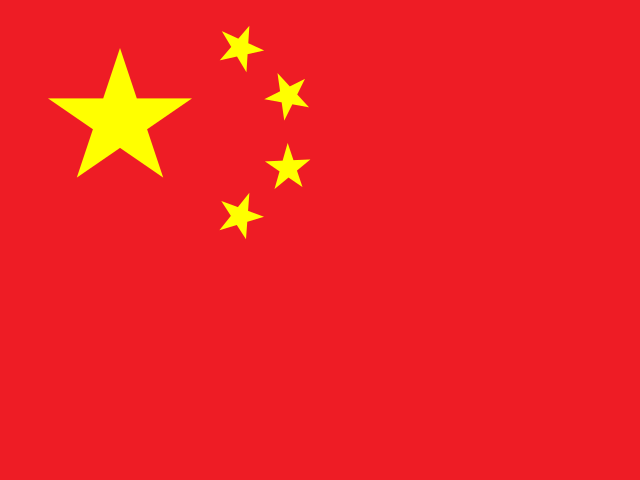 China
China
The start, 770 BCE, matches the move of the Zhou court east. The end is a matter of convention: the Chunqiu chronicle, traditionally attributed to Confucius, ends in 481 BCE, textbooks often say 476 BCE, and some historians run the period to 403 BCE, when the state of Jin formally split in three.
Before and after
In the Central Plains of China:Came before: Western Zhou Came after: Warring States period
Meanwhile…
- Chavín culture
 South America ·
 When archaeologists sent water rushing through the temple's stone canals, the roar it made suggested the priests had built them to sound like a jaguar.
Compare - Maya civilization
 Mesoamerica · Longest-lasting hereCompare
 - Ancient GreeceἙλλάς
 Europe ·
 There were over a thousand Greek city-states, most no bigger than a small town, each with its own laws, coins and calendar.
Compare - Ancient EgyptKemet (km.t)
 Africa · Oldest here (disputed dates)
While Nubian kings ruled from Napata to the Delta, the Eastern Zhou court sat at Luoyang, and Rome was still a cluster of hut villages on its hills.
Compare - Paracas culture South America · Compare
- Olmec civilization Mesoamerica ·
Olmec art repeats a half-human, half-jaguar infant face so often that archaeologists call it the "were-jaguar".
Compare
Named after a terse chronicle of the state of Lu, this is the first three centuries after the Zhou court fled east: nominal Zhou kings kept a religious authority while real power passed to rival regional lords. Warfare between a shifting handful of great states, and the rise of a wandering teacher named Confucius, defined the age.
Also alive at the same time
Key events
The Zhou court, driven from Haojing, resettles at Luoyi and never again commands its lords directly
Sources
- Hsu, Cho-yun (1999). "The Spring and Autumn Period." In Loewe & Shaughnessy (eds), The Cambridge History of Ancient China, 545–586. Cambridge University Press.
- Lewis, Mark Edward (2007). The Early Chinese Empires: Qin and Han. Harvard University Press.
Also happening around
Duke Huan of Qi is recognised as the first hegemon, leading alliances of states in the Zhou king's name
Sources
- Hsu, Cho-yun (1999). "The Spring and Autumn Period." In Loewe & Shaughnessy (eds), The Cambridge History of Ancient China, 545–586. Cambridge University Press.
- Lewis, Mark Edward (2007). The Early Chinese Empires: Qin and Han. Harvard University Press.
– Cast-iron tools and ox-drawn ploughs spread across the Yellow and Yangzi valleys, lifting farm output
Sources
- Hsu, Cho-yun (1999). "The Spring and Autumn Period." In Loewe & Shaughnessy (eds), The Cambridge History of Ancient China, 545–586. Cambridge University Press.
- Lewis, Mark Edward (2007). The Early Chinese Empires: Qin and Han. Harvard University Press.
– Confucius teaches a philosophy of ritual, duty and benevolent rule that later dynasties adopt as state orthodoxy
Sources
- Hsu, Cho-yun (1999). "The Spring and Autumn Period." In Loewe & Shaughnessy (eds), The Cambridge History of Ancient China, 545–586. Cambridge University Press.
- Lewis, Mark Edward (2007). The Early Chinese Empires: Qin and Han. Harvard University Press.
– The southern states of Wu and Yue fight a generation-long war, ending with Yue's conquest of Wu
Sources
- Hsu, Cho-yun (1999). "The Spring and Autumn Period." In Loewe & Shaughnessy (eds), The Cambridge History of Ancient China, 545–586. Cambridge University Press.
- Lewis, Mark Edward (1999). "Warring States Political History." In Loewe & Shaughnessy (eds), The Cambridge History of Ancient China, 587–650. Cambridge University Press.
– The great state of Jin fractures into Han, Zhao and Wei, a split the Zhou king formally recognises in 403 BCEDisputed
Many historians treat this partition as the true start of the Warring States period.
Sources
- Lewis, Mark Edward (1999). "Warring States Political History." In Loewe & Shaughnessy (eds), The Cambridge History of Ancient China, 587–650. Cambridge University Press.
- Lewis, Mark Edward (2007). The Early Chinese Empires: Qin and Han. Harvard University Press.
Also happening around
- Paracas cultureSouth America
- Maya civilizationMesoamerica
- Olmec civilizationMesoamerica
- Zapotec civilizationMesoamerica
- Etruscan civilizationEurope
- Ancient GreeceEurope
- Celtic Iron AgeEurope
- Ancient RomeEurope
- Ancient EgyptAfrica
- Warring States periodChina (uncertain overlap)
- Chavín cultureSouth America (uncertain overlap)
- Mixtec civilizationMesoamerica (uncertain overlap)