World War II
Most historians date the war from Germany's attack on Poland on 1 September 1939; some date the war in Asia from the start of full-scale war between Japan and China in July 1937, or from Japan's seizure of Manchuria in 1931.
Sides
Soviet Union (from 1941),  United States,
  United Kingdom, Republic of China (Nationalist government),
  France, and Second Polish Republic
Nazi Germany, Empire of Japan, and Kingdom of Italy (until 1943)
Countries today:  China,
 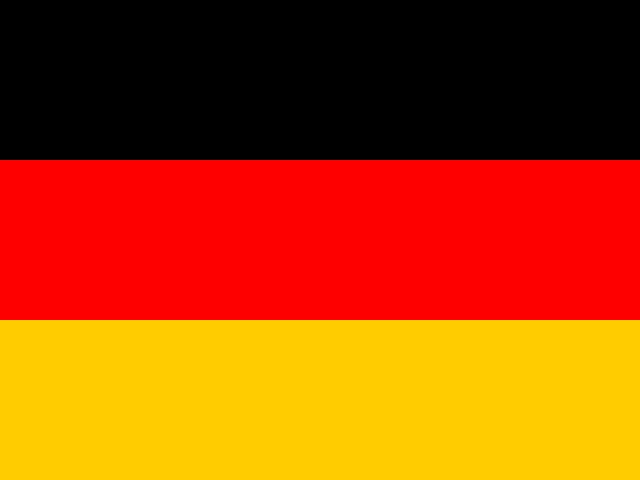 Germany,
 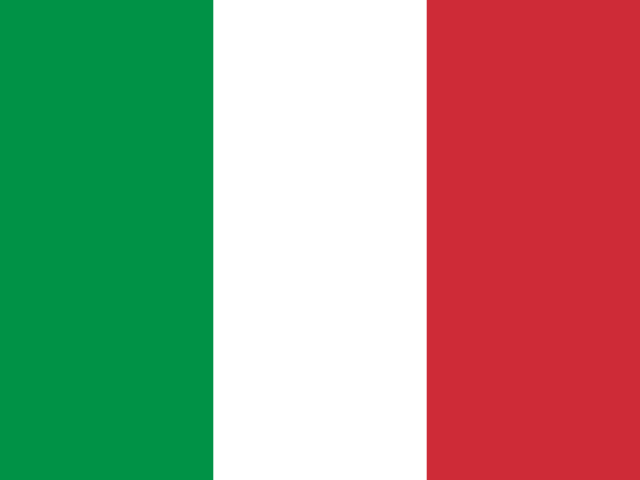 Italy,
 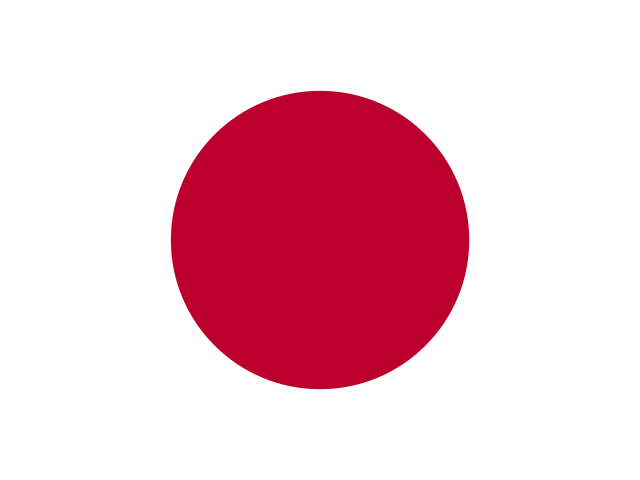 Japan,
 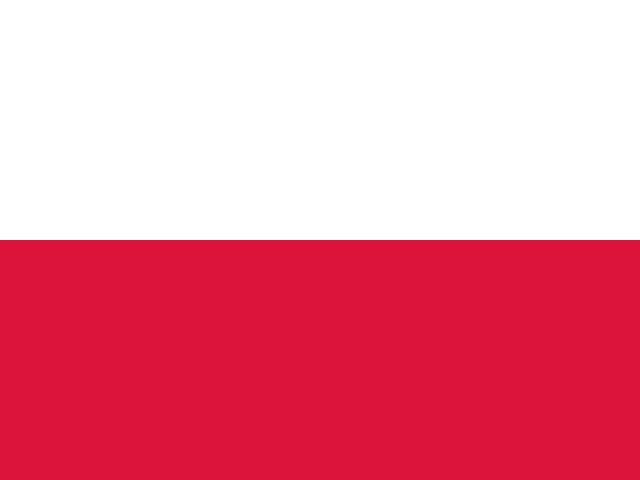 Poland, and
  Russia
What happened
Germany attacked Poland on 1 September 1939, and Britain and France declared war on Germany two days later; Japan and China had been at war since 1937. In 1940 Germany defeated France and occupied much of western Europe, while Britain fought on. In June 1941 Germany and its allies attacked the Soviet Union, and in December Japan attacked the US fleet at Pearl Harbor and British territories in Asia, bringing the United States into the war. The Axis (Germany, Japan, Italy and partners such as Hungary and Romania) fought the Allies (the Soviet Union, the United States, the British Empire, China, Free France, Poland and many others). Nazi Germany and its collaborators murdered about six million Jews in the Holocaust, and millions of other civilians and prisoners. The Soviet victory at Stalingrad in early 1943 and the Normandy landings of June 1944 turned the war in Europe; Soviet troops took Berlin, and Germany surrendered on 8 May 1945. The United States dropped atomic bombs on Hiroshima and Nagasaki in August, the Soviet Union attacked Japanese forces in Manchuria, and Japan signed its surrender on 2 September 1945.
Outcome: The Allies won: Germany surrendered unconditionally on 8 May 1945 and Japan on 2 September 1945.
Key events
Leaders
- Joseph Stalin · Leader of the Soviet Union · Allies
- Franklin D. Roosevelt · President of the United States until his death in April 1945 · Allies
- Winston Churchill · Prime Minister of the United Kingdom from May 1940 · Allies
- Chiang Kai-shek · Chairman of China's Military Affairs Commission (1937–1945) · Allies
- Georgy Zhukov · Soviet marshal; led the attack on Berlin · Allies
- Dwight D. Eisenhower · Supreme commander of the Allied forces in western Europe · Allies
- Adolf Hitler · Dictator of Germany · Axis
- Hirohito · Emperor of Japan · Axis
- Hideki Tojo · Prime Minister of Japan, 1941–1944 · Axis
- Benito Mussolini · Dictator of Italy until 1943 · Axis
Deaths
Death tolls are estimates and often contested. Each is a range from its sources; a figure one party gives is marked as theirs.
Total deaths · All sides
- 50,000,000 – 75,000,000
Soldiers and civilians of all countries, including those murdered in the Holocaust and other mass killings and those who died of famine and disease; most were civilians. EBSCO says most estimates centre on about 50 million, while English Wikipedia gives 60–75 million. The National WWII Museum puts Soviet deaths at about 24 million and Chinese deaths at about 20 million. Estimates vary widely.
Sources
- "World War II." EBSCO Research Starters: Military History and Science.
- The National WWII Museum. "Research Starters: Worldwide Deaths in World War II."
- Wikipedia (English). "World War II."
- Wikipedia (español). "Segunda Guerra Mundial."
- Wikipedia (中文). "第二次世界大战."
- Wikipedia (English). "World War II casualties."