Iran–Iraq War
- Iran calls it جنگ تحمیلی (The Imposed War)
- Iran calls it دفاع مقدس (The Sacred Defence)
- Iraq calls it قادسية صدام (Saddam's Qadisiyyah)
See this year on the world timeline
Sides
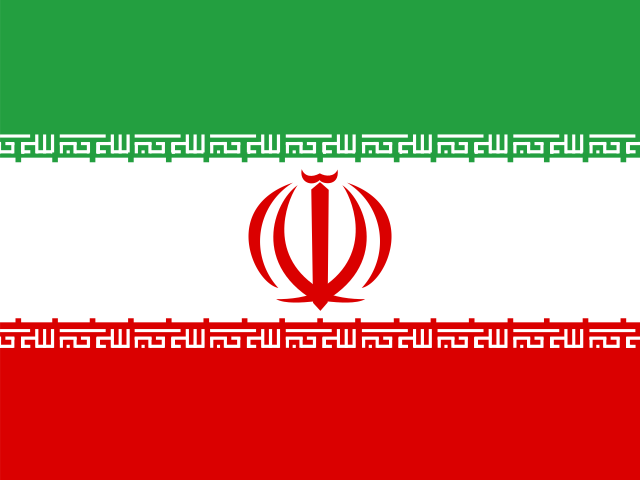 Iran
Iran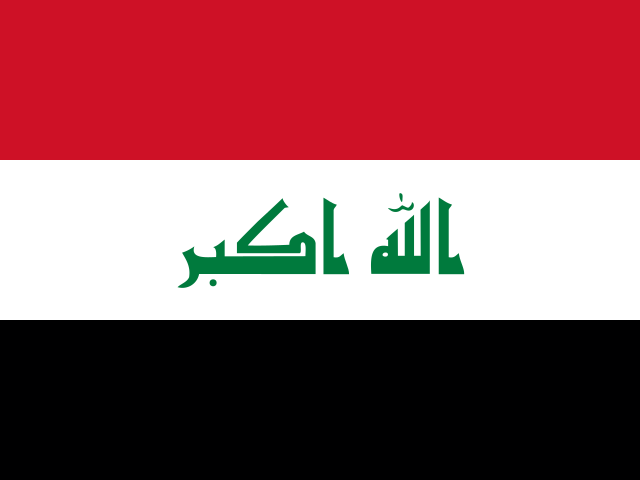 Iraq
IraqWhat happened
After the 1979 revolution in Iran, Iraq's president Saddam Hussein and Iran's new leader Ayatollah Khomeini each called for the other's overthrow, and the two states disputed the Shatt al-Arab border. On 22 September 1980 Iraqi forces crossed into Iran. They took Khorramshahr but stalled before Abadan. Iran's army and Revolutionary Guards broke the siege of Abadan in 1981 and took Khorramshahr back in May 1982. Iran refused Saddam's offer to withdraw and carried the war into Iraq; years of attrition followed. Iraq used chemical weapons from the mid-1980s, and both sides fired missiles at each other's cities and attacked oil tankers in the Gulf. Saudi Arabia, Kuwait and other Gulf states lent Iraq tens of billions of dollars, the Soviet Union and France sold it arms, and the United States gave it credits and intelligence. China sold arms to both sides and North Korea to Iran; Syria and Libya backed Iran. The United States also sold Iran missiles in secret (the Iran–Contra affair), and in 1987–88 US warships destroyed Iranian oil platforms. Iran accepted UN Security Council Resolution 598 in July 1988, and a ceasefire took effect on 20 August with neither side having won its aims.
Outcome: A UN-brokered ceasefire under Resolution 598 took effect on 20 August 1988 with neither side victorious; in 1990 Iraq withdrew from the last Iranian land it held and accepted the pre-war border.
Key events
Leaders
- Ruhollah Khomeini · Supreme Leader of Iran · Iran
- Ali Khamenei · President of Iran from 1981 · Iran
- Akbar Hashemi Rafsanjani · Speaker of parliament; acting commander-in-chief in 1988 · Iran
- Saddam Hussein · President of Iraq · Iraq
- Ali Hassan al-Majid · Commander in northern Iraq, 1987–1989 · Iraq
Deaths
Death tolls are estimates and often contested. Each is a range from its sources; a figure one party gives is marked as theirs.
Total deaths · All sides
- 367,000 – 1,000,000
Soldiers and civilians on both sides. Published estimates run from about 367,000 (a conservative Western count cited by the historian Dilip Hiro) to about a million, a figure used in many reference works; the median of the estimates compiled by Necrometrics is about 700,000. Iran's and Iraq's own figures are lower than most independent ones. The tolls are contested.
Sources
- Burch, Kurt. "Iran-Iraq War." EBSCO Research Starters: History, 2021.
- White, Matthew. "Iran-Iraq War (1980-88)." Necrometrics: Death Tolls across History, compiling published estimates.
- Wikipedia (English). "Iran–Iraq War."
- Wikipedia (español). "Guerra Irán-Irak."
- Wikipedia (中文). "两伊战争."
- Antoon, Sinan. "Monumental Disrespect." Middle East Report Online (MERIP), 6 September 2003.
- Battle, Joyce (ed.). "Shaking Hands with Saddam Hussein: The U.S. Tilts toward Iraq, 1980-1984." National Security Archive Electronic Briefing Book No. 82, 25 February 2003.
- Stork, Joe. "Arms Merchants in the Gulf War." MERIP Reports 125/126, July 1984.
- International Court of Justice. Oil Platforms (Islamic Republic of Iran v. United States of America), case overview.