Indian Rebellion of 1857
- India calls it प्रथम भारतीय स्वतंत्रता संग्राम (First Indian War of Independence)
- Pakistan calls it جنگ آزادی ہند 1857ء (Indian War of Independence of 1857)
- British accounts calls it Indian Mutiny (Indian Mutiny)
The end date depends on the measure: the rebels lost Gwalior on 20 June 1858, the Crown offered an amnesty on 1 November 1858, Tatya Tope was hanged in April 1859, and the British declared the hostilities over on 8 July 1859.
Phases
- 1.Meerut, Delhi, Cawnpore and the siege of Lucknow
- 2.Lucknow retaken and the central India campaign
- 3.Last resistance
Sides
Mutinous regiments of the Company's Bengal Army, The Mughal court at Delhi, under Bahadur Shah Zafar, Nana Sahib's forces at Cawnpore, Awadh rebels under Begum Hazrat Mahal, Jhansi, under Rani Lakshmibai, and Jagdishpur, under Kunwar Singh
East India Company forces, British Army regiments sent by the Crown, Indian soldiers who fought for the Company: sepoy regiments that stayed with it, Sikh, Punjabi Muslim and Pashtun units raised in the Punjab, and Gurkha battalions, Sikh princely states of Patiala, Nabha and Kapurthala, Gwalior, under Maharaja Jayajirao Scindia (supporting), Rampur, under Nawab Yusuf Ali Khan, Jodhpur, under Maharaja Takht Singh, and Kingdom of Nepal, under Jung Bahadur Rana
Countries today: 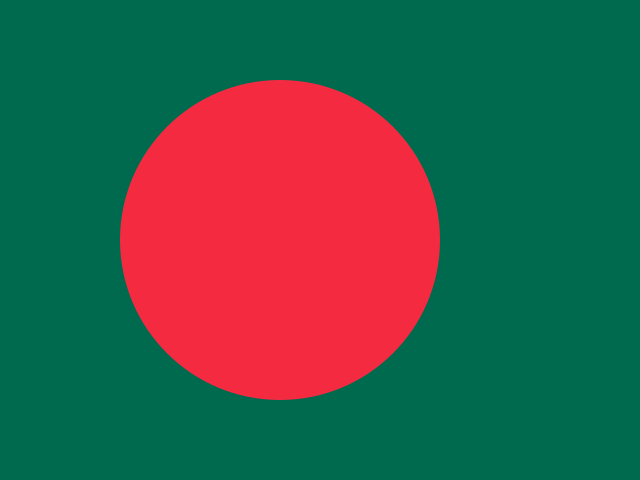 Bangladesh,
 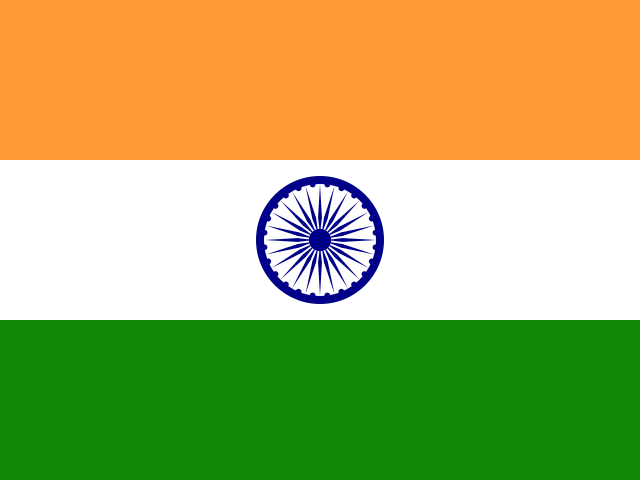 India,
 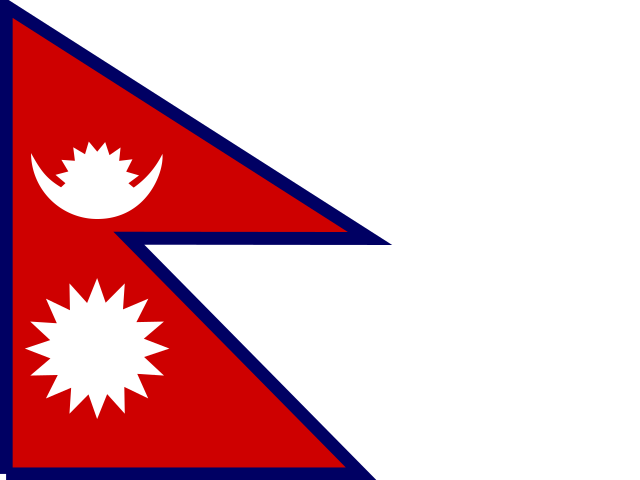 Nepal,
 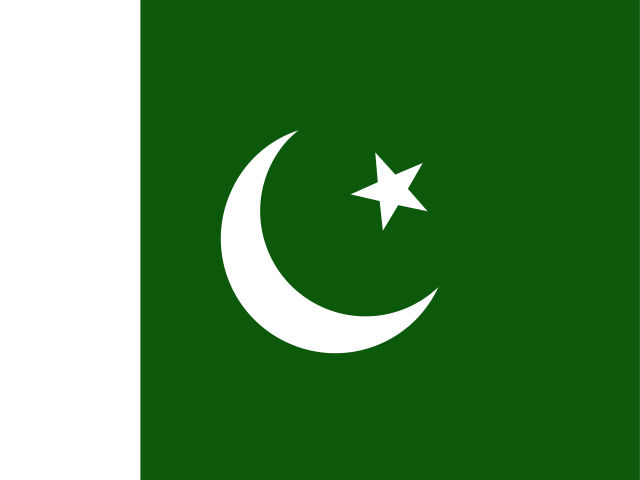 Pakistan, and
  United Kingdom
What happened
The rebellion began on 10 May 1857 at Meerut, where sepoys of the East India Company's Bengal Army freed comrades jailed for refusing cartridges they believed were greased with cow and pig fat, killed British officers and civilians, and marched to Delhi. There they made the aged Mughal emperor Bahadur Shah Zafar their figurehead. Mutinies and civilian risings spread across the upper Ganges plain and central India, led at Cawnpore by Nana Sahib, in Awadh by Begum Hazrat Mahal, in Bihar by Kunwar Singh and at Jhansi by Rani Lakshmibai. Both sides killed civilians: rebels killed British men, women and children at Cawnpore and elsewhere, and Company columns burned villages and hanged or shot prisoners and townspeople. East India Company forces, British Army regiments, Sikh and Punjabi units and Sikh princely states took Delhi in September 1857; with a Nepalese army under Jung Bahadur Rana they took Lucknow in March 1858, and Sir Hugh Rose's Central India Field Force took Gwalior in June 1858. In 1858 the British Parliament ended Company rule, and the Crown took over the government of India.
Outcome: Company and allied forces took the last rebel centres by mid-1858; the British Crown took over the government of India from the East India Company, and the last Mughal emperor was exiled to Rangoon.
Key events
Leaders
- Bahadur Shah Zafar · Mughal emperor at Delhi, proclaimed leader by the rebels · Rebel sepoys, the Mughal court at Delhi and allied rulers
- Nana Sahib · Led the rebels at Cawnpore · Rebel sepoys, the Mughal court at Delhi and allied rulers
- Rani Lakshmibai · Rani of Jhansi; killed at Gwalior in 1858 · Rebel sepoys, the Mughal court at Delhi and allied rulers
- Tatya Tope · Nana Sahib's general; hanged in 1859 · Rebel sepoys, the Mughal court at Delhi and allied rulers
- Bakht Khan · Commander of the rebel forces in Delhi · Rebel sepoys, the Mughal court at Delhi and allied rulers
- Begum Hazrat Mahal · Led the rebellion in Awadh · Rebel sepoys, the Mughal court at Delhi and allied rulers
- Kunwar Singh · Zamindar of Jagdishpur; led the rebellion in Bihar · Rebel sepoys, the Mughal court at Delhi and allied rulers
- Charles Canning · Governor-General of India; from 1858 the first Viceroy · East India Company forces, the British Army and their allies
- Colin Campbell · Commander-in-Chief in India; relieved and later took Lucknow · East India Company forces, the British Army and their allies
- Hugh Rose · Commanded the Central India Field Force · East India Company forces, the British Army and their allies
- Henry Havelock · Retook Cawnpore and led the first relief of Lucknow; died there in November 1857 · East India Company forces, the British Army and their allies
- James Outram · Commander at Lucknow and the Alambagh · East India Company forces, the British Army and their allies
- Henry Lawrence · Chief Commissioner of Awadh; killed in the siege of Lucknow · East India Company forces, the British Army and their allies
- Archdale Wilson · Commanded the force that took Delhi · East India Company forces, the British Army and their allies
- John Nicholson · Led the Punjab column to Delhi; mortally wounded in the assault · East India Company forces, the British Army and their allies
- Jung Bahadur Rana · Prime minister of Nepal; led the Nepalese army at Lucknow · East India Company forces, the British Army and their allies
Deaths
Death tolls are estimates and often contested. Each is a range from its sources; a figure one party gives is marked as theirs.
Total deaths · Europeans in India, soldiers and civilians
- 6,000according to historian Douglas M. Peers
A rough estimate: about 6,000 of the roughly 40,000 Europeans then in India were killed. No source gives a firm count of the Indian soldiers who died fighting for the Company.
Total deaths · Indians
- 800,000according to historian Douglas M. Peers
Indians killed in the fighting and in the famines and epidemics it caused, estimated by comparing unreliable pre-1857 data with the 1871 census; Peers says the true toll was very likely higher. The toll is contested: the historian Saul David puts it in the hundreds of thousands, while the writer Amaresh Misra has claimed almost 10 million deaths over the ten years from 1857, a figure other historians reject.
Meanwhile, elsewhere in
Sources
- Wikipedia (English). "Indian Rebellion of 1857."
- Wikipedia (español). "Rebelión de la India de 1857."
- Wikipedia (中文). "印度民族起义."
- National Army Museum. "Decisive events of the Indian Rebellion."
- National Army Museum. "Why did the Indian Rebellion happen?"
- Sky HISTORY. "How the Indian Mutiny forever changed the landscape of the British Empire."
- Ramesh, Randeep. "Millions died after 1857 war of independence: historian." The Guardian, via Dawn, 2007.
- Banglapedia. "Chittagong City." Asiatic Society of Bangladesh (archived 30 November 2021).
- "Revisiting the great rebellion of 1857." The Daily Star (Dhaka) (archived 26 June 2018).
- Wikipedia (English). "Rampur State."
- RoyalArk. "Rampur: Muhammad Yusuf Ali Khan."
- Wikipedia (English). "Kushal Singh of Auwa."
- RajRAS. "Revolt of 1857 in Rajasthan."