First Indochina War
- Vietnam calls it Kháng chiến chống thực dân Pháp (Resistance War against the French colonialists)
Some historians date the war from the French return to Saigon on 23 September 1945; others from the outbreak of full-scale war in Hanoi on 19 December 1946. The Geneva armistices of 21 July 1954 ended it; the last fighting stopped in August.
Phases
- 1.Return of the French and outbreak of war
- 2.Chinese and US aid; battles for the delta and the highlands
- 3.Điện Biên Phủ and Geneva
Sides
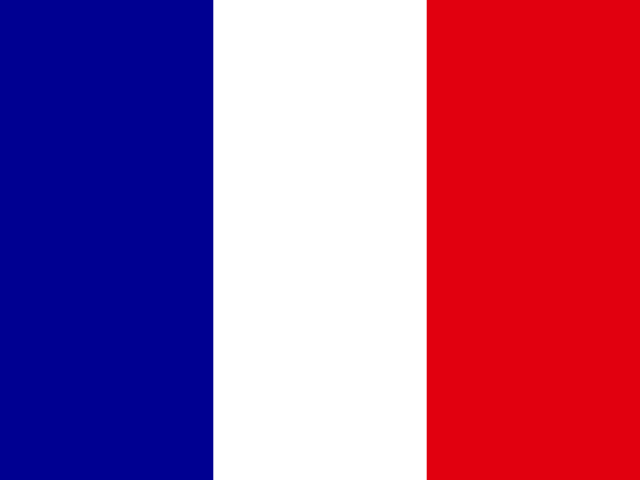 France, State of Vietnam, Kingdom of Laos, Kingdom of Cambodia, and
 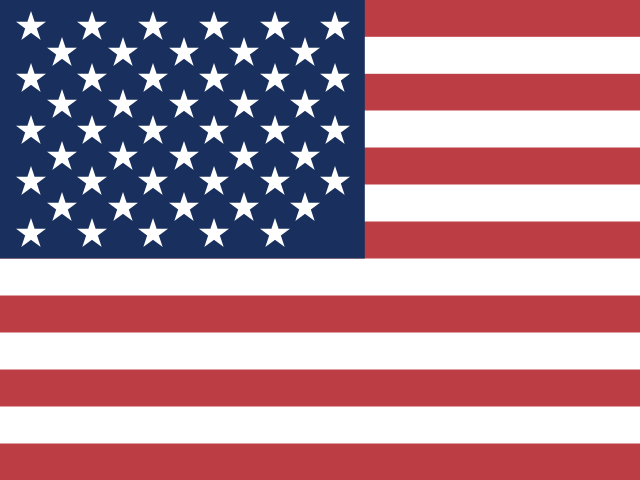 United States (supporting)
Democratic Republic of Vietnam (Viet Minh), Pathet Lao, Khmer Issarak (United Issarak Front), 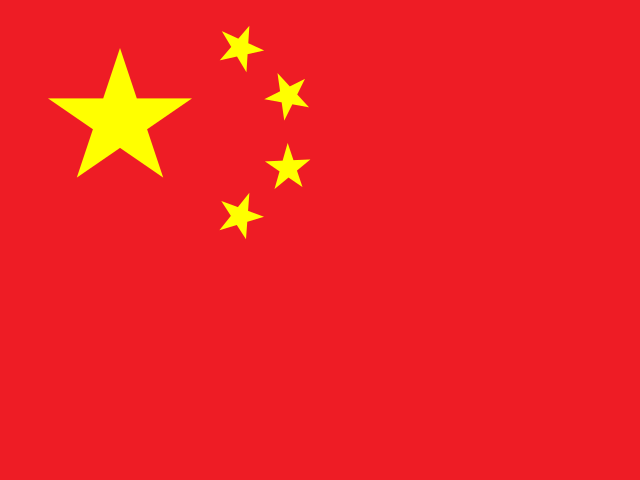 China (supporting), and Soviet Union (supporting)
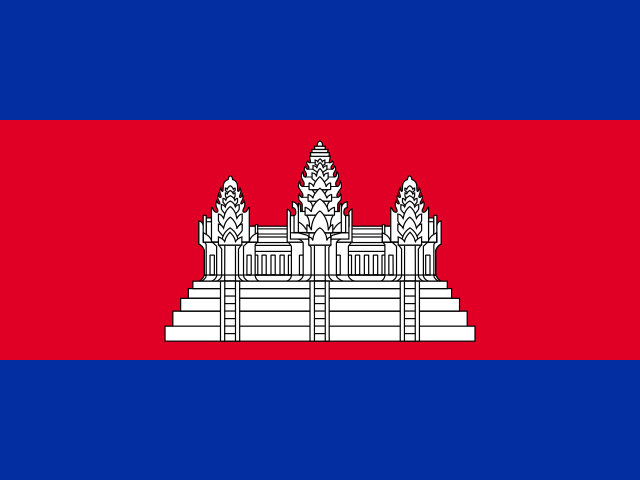 Cambodia
 Laos
Laos Russia
 Vietnam
What happened
After decades of French rule, Japanese troops entered Indochina in September 1940 and ousted the French administration in March 1945. Ho Chi Minh proclaimed the Democratic Republic of Vietnam in Hanoi in September 1945, weeks before French troops took back Saigon; fighting followed in the south. Talks failed: French forces shelled Haiphong in November 1946, and full-scale war began in Hanoi on 19 December. The French Union's forces included Foreign Legion, North and sub-Saharan African and Indochinese troops, and from 1949 France backed a State of Vietnam under Bảo Đại. After the communist victory in China, the Viet Minh received Chinese arms, supplies and advisers and some Soviet aid, while from 1950 the United States sent France money and equipment. In October 1950 Viet Minh divisions destroyed French columns on Route Coloniale 4 by the Chinese border. Their attacks on the Red River delta in 1951 failed, but in 1953 they moved into Laos. General Navarre answered with an entrenched camp at Điện Biên Phủ, which fell on 7 May 1954 after nearly two months of siege. At Geneva in July, armistices split Vietnam at the 17th parallel pending elections.
Outcome: France agreed at Geneva to armistices that left the Democratic Republic of Vietnam in the north and the State of Vietnam in the south, divided at the 17th parallel; the last French troops left the south in April 1956.
Key events
Leaders
- Ho Chi Minh · President of the Democratic Republic of Vietnam · Viet Minh (Democratic Republic of Vietnam) and allies
- Võ Nguyên Giáp · Commander-in-chief of the Viet Minh army · Viet Minh (Democratic Republic of Vietnam) and allies
- Phạm Văn Đồng · Led the DRV delegation at Geneva · Viet Minh (Democratic Republic of Vietnam) and allies
- Souphanouvong · Leader of the Lao resistance government · Viet Minh (Democratic Republic of Vietnam) and allies
- Wei Guoqing · Head of the Chinese Military Advisory Delegation · Viet Minh (Democratic Republic of Vietnam) and allies
- Chen Geng · Chinese adviser for the 1950 border campaign · Viet Minh (Democratic Republic of Vietnam) and allies
- Georges Thierry d'Argenlieu · French high commissioner in Indochina, 1945–1947 · French Union: France and the Associated States of Vietnam, Laos and Cambodia
- Philippe Leclerc de Hauteclocque · Commander of the French expeditionary corps, 1945–1946 · French Union: France and the Associated States of Vietnam, Laos and Cambodia
- Jean-Étienne Valluy · French commander, 1946–1948 · French Union: France and the Associated States of Vietnam, Laos and Cambodia
- Jean de Lattre de Tassigny · High commissioner and commander-in-chief, 1950–1951 · French Union: France and the Associated States of Vietnam, Laos and Cambodia
- Raoul Salan · Commander-in-chief, 1952–1953 · French Union: France and the Associated States of Vietnam, Laos and Cambodia
- Henri Navarre · Commander-in-chief, 1953–1954 · French Union: France and the Associated States of Vietnam, Laos and Cambodia
- Christian de Castries · Commander of the camp at Điện Biên Phủ · French Union: France and the Associated States of Vietnam, Laos and Cambodia
- Bảo Đại · Head of the State of Vietnam from 1949 · French Union: France and the Associated States of Vietnam, Laos and Cambodia
Deaths
Death tolls are estimates and often contested. Each is a range from its sources; a figure one party gives is marked as theirs.
Military deaths · French Union: France and the Associated States of Vietnam, Laos and Cambodia
- 92,800according to French official statistics, 1955
French Union troops killed, dead of disease or missing up to the armistices of mid-1954: about 20,700 French nationals, 15,200 North and sub-Saharan Africans, 11,600 Foreign Legion, 27,700 Indochinese regulars and 17,600 auxiliaries and Associated States troops. The historian Michel Bodin, who also counts deaths in captivity after the armistices, gives 112,032.
Military deaths · Viet Minh (Democratic Republic of Vietnam) and allies
- 175,000 – 300,000
Estimates by Western historians and datasets: Christopher Goscha cites Clodfelter for about 175,000 and Lacina and Gleditsch for a more methodical 300,000. A French figure of 500,000 Vietnamese dead, repeated in some references, seems to include civilians and traces back to a single memoir.
- 191,605according to Vietnamese Ministry of Defence (2015)
The number recorded as "liệt sĩ" (martyrs, the official term for those who died in service) in the war against France, in a Ministry of Defence report on recovering remains. Christopher Goscha writes that Vietnam has never published its armed forces' total losses for 1945–1954.
Total deaths · All sides
- 400,000 – 600,000
Soldiers and civilians of all sides, 1945–1954: about 400,000 according to the historian Christopher Goscha, about 600,000 according to the Larousse encyclopedia.
Sources
- Wikipedia (English). "First Indochina War."
- Goscha, Christopher E. "19 December 1946." Historical Dictionary of the Indochina War (1945–1954). Université du Québec à Montréal.
- Goscha, Christopher E. "Casualties, Indochina War." Historical Dictionary of the Indochina War (1945–1954). Université du Québec à Montréal.
- Goscha, Christopher E. "Điện Biên Phủ, Battle of (13 March–7 May 1954)." Historical Dictionary of the Indochina War (1945–1954). Université du Québec à Montréal.
- Goscha, Christopher E. "Geneva Accords." Historical Dictionary of the Indochina War (1945–1954). Université du Québec à Montréal.
- Goscha, Christopher E. "Aid, American." Historical Dictionary of the Indochina War (1945–1954). Université du Québec à Montréal.
- Goscha, Christopher E. "Aid, Chinese Communist." Historical Dictionary of the Indochina War (1945–1954). Université du Québec à Montréal.
- Goscha, Christopher E. "Aid, Soviet." Historical Dictionary of the Indochina War (1945–1954). Université du Québec à Montréal.
- "Guerre d'Indochine (1940-1954)." Encyclopédie Larousse.
- Office of the Historian, U.S. Department of State. "Dien Bien Phu & the Fall of French Indochina, 1954." Milestones in the History of U.S. Foreign Relations.
- Wikipedia (français). "Guerre d'Indochine."
- Ministry of Defence of Vietnam, General Political Department, Policy Department. "Chuyên đề 4: Công tác tìm kiếm, quy tập hài cốt liệt sĩ từ nay đến năm 2020 và những năm tiếp theo" (2015), archived copy.