Second Sino-Japanese War
- China calls it 中国人民抗日战争 (The Chinese People's War of Resistance against Japanese Aggression)
- Japan calls it 日中戦争 (Japan–China War)
The start is disputed. Most international histories date the war from the Marco Polo Bridge incident of 7 July 1937; since 2017 China's official histories count a fourteen-year war from the Mukden incident of 18 September 1931. Japan's forces in China surrendered on 9 September 1945.
Sides
Republic of China (Nationalist government), Communist-led Eighth Route Army and New Fourth Army, Soviet Volunteer Group (1937–1941), and 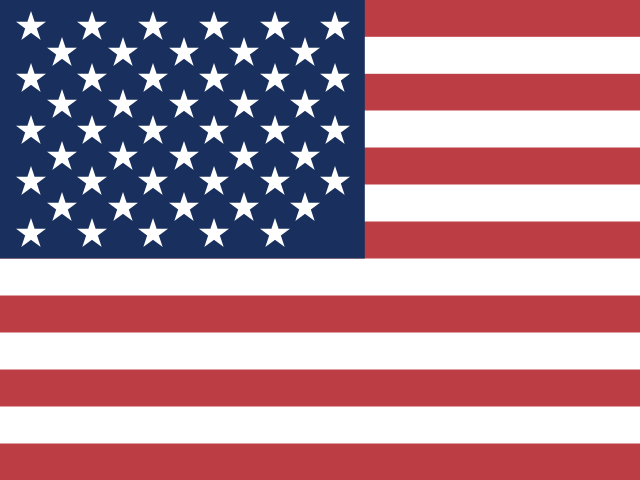 United States
Empire of Japan, Manchukuo, Wang Jingwei regime (Nanjing, 1940–1945), and Mengjiang
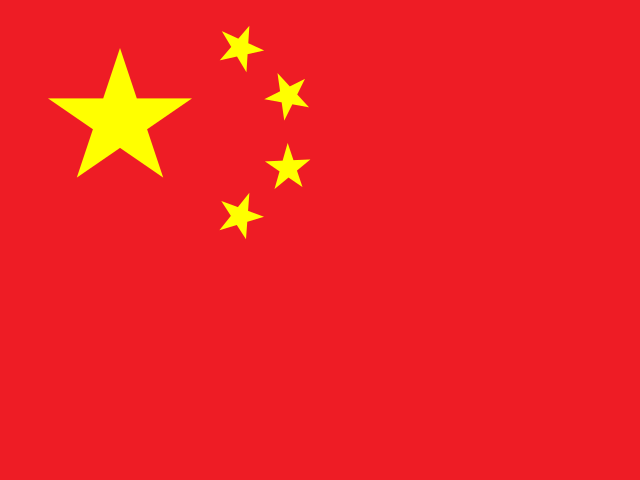 China
China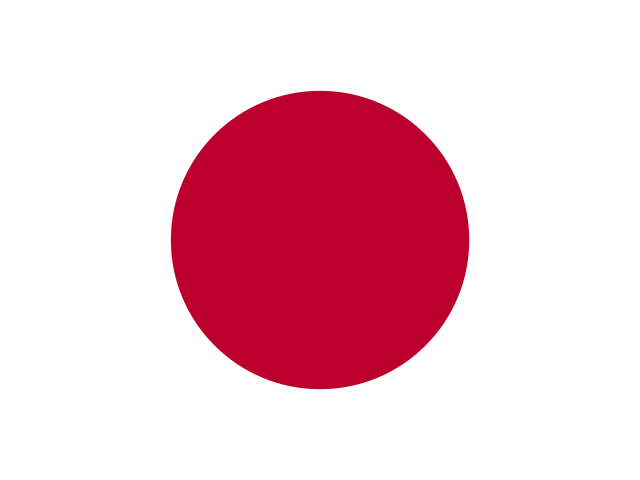 Japan
Japan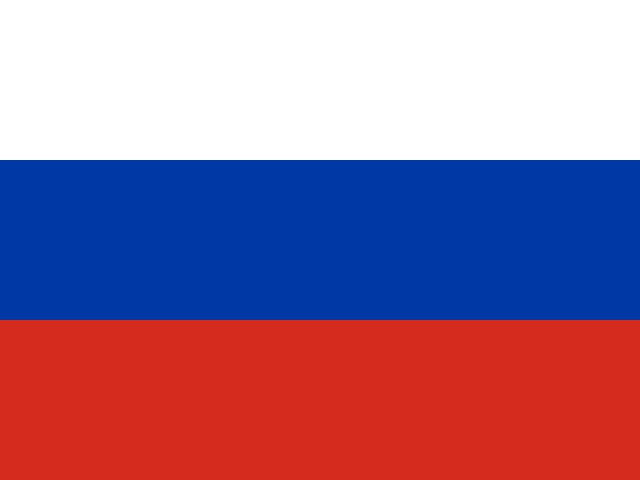 Russia
What happened
In September 1931 Japan's Kwantung Army used an explosion on the railway near Mukden as a pretext to occupy Manchuria, where Japan set up the state of Manchukuo in 1932. After troops clashed at the Marco Polo Bridge near Beiping on 7 July 1937, full-scale war followed. Japanese forces took Shanghai after three months of fighting and the capital, Nanjing, in December 1937, where Japanese troops killed large numbers of prisoners and civilians. The Nationalist government moved inland, to Wuhan and then Chongqing, while Communist-led forces fought behind Japanese lines in the north. Chinese forces won at Taierzhuang in 1938, but Japan held most large cities, railways and the coast, and in 1940 installed a collaborationist government under Wang Jingwei in Nanjing. The Soviet Union sent aid and volunteer airmen from 1937; after Pearl Harbor in December 1941 the war became part of the Second World War, with the United States fighting alongside China. Japan's Ichi-Go offensive of 1944 overran much of central and southern China. Japan's forces in China surrendered at Nanjing on 9 September 1945.
Outcome: Japan surrendered to the Allies in August 1945, and its forces in China surrendered at Nanjing on 9 September 1945; Manchukuo and the Wang Jingwei government ended with them.
Key events
Leaders
- Chiang Kai-shek · Head of the Nationalist government and commander-in-chief · China: the Nationalist government, Communist-led forces and their allies
- Mao Zedong · Leader of the Chinese Communist Party · China: the Nationalist government, Communist-led forces and their allies
- Zhu De · Commander of the Eighth Route Army · China: the Nationalist government, Communist-led forces and their allies
- Peng Dehuai · Deputy commander of the Eighth Route Army; led the Hundred Regiments Offensive · China: the Nationalist government, Communist-led forces and their allies
- Li Zongren · Nationalist commander at Taierzhuang · China: the Nationalist government, Communist-led forces and their allies
- Joseph Stilwell · US general; chief of staff to Chiang Kai-shek, 1942–1944 · China: the Nationalist government, Communist-led forces and their allies
- Hirohito · Emperor of Japan · Empire of Japan and its client governments
- Fumimaro Konoe · Prime minister of Japan in 1937–1939 and 1940–1941 · Empire of Japan and its client governments
- Iwane Matsui · Commander at Shanghai and Nanjing, 1937; executed after the Tokyo tribunal · Empire of Japan and its client governments
- Yasuji Okamura · Commander of the China Expeditionary Army; signed the surrender in Nanjing · Empire of Japan and its client governments
- Wang Jingwei · Head of the Japanese-backed government in Nanjing · Empire of Japan and its client governments
Deaths
Death tolls are estimates and often contested. Each is a range from its sources; a figure one party gives is marked as theirs.
Total deaths · Chinese soldiers and civilians
- 14,000,000 – 22,000,000
Rough estimates: about 14 million (Arne Westad, a figure Rana Mitter calls conservative), 15 to 16 million (the consensus range Victor Davis Hanson reports), about 20 million (Duncan Anderson; Barrett and Shyu give about 20 million deaths in the war, mostly civilians) and up to 22 million (Clodfelter). China's government cites 35 million Chinese casualties, killed and wounded.
Military deaths · Nationalist armed forces
- 1,319,958according to Nationalist government official figures
Regular army only, 1937–1945. Other estimates, such as R. J. Rummel's, put Chinese military dead and missing at 3 to 4 million.
Military deaths · Japanese armed forces
- 455,700 – 700,000
From Japanese records; the low figure is from the Chidorigafuchi National Cemetery, the high from a 1983 Yomiuri Shimbun history.
Sources
- Wikipedia (English). "Second Sino-Japanese War."
- Wikipedia (中文). "中国抗日战争."
- Wikipedia (español). "Segunda guerra sino-japonesa."
- Wikipedia (français). "Guerre sino-japonaise (1937-1945)."
- Office of the Historian, U.S. Department of State. "The Mukden Incident of 1931 and the Stimson Doctrine."
- "Japan and the Two World Wars." Encyclopedia of Modern Europe: Europe Since 1914. Charles Scribner's Sons, via Encyclopedia.com.
- "Sino-Japanese Wars." World Encyclopedia. Oxford University Press, via Encyclopedia.com.
- International Military Tribunal for the Far East. Judgment (November 1948), Chapter VIII: Conventional War Crimes (Atrocities), via HyperWar.
- Xinhua, via english.www.gov.cn. "China holds national memorial for Nanjing Massacre victims, calling for remembrance of history." 13 December 2025.
- Wikipedia (English). "Nanjing Massacre."